Instead of superficial self-introductions, I dare to talk about my past failures in a funny way.
Analysis of Engagement Survey:
If the organization conducts an Engagement Survey or similar assessment, I make sure to grasp its results. The focus of analysis lies in observing the scores and changes. Scores indicate the evaluation of each item, while changes allow us to understand trends compared to previous surveys. This is a practice many might already be familiar with.
Nowadays, AI can propose issues and actions based on surveys, which I also consider as valuable insights and take them as facts. In addition to analyzing score values and changes for each question, I place great importance on free comments. I make it a point to read every single one. As I believe that the free comments are written by the individuals who dared to take the time to write them in their own words, I believe that their thoughts and feelings are contained in them. Beyond understanding the content, I pay attention to the words and phrases used, whether positive or negative. This enables me to better imagine the organization's situation and anticipate potential challenges.
One-on-One Meetings with Stakeholders:
I meet individually with stakeholders within the organization, allocating 30 minutes to 1 hour for the initial meeting. At this stage, building rapport is crucial. Therefore, while striving to understand the other party, I also make an effort to be as open as possible about myself.
Here, I am conscious of the reciprocity principle. To put it simply, it's the notion that "actions taken will receive similar reactions." While I first check with them whether they want to introduce themselves first or they'd like me to first, if they don't mind, I try to introduce myself first. Instead of superficial self-introductions here, I dare to talk about my past failures in a funny way, too. In situations where people are speaking with an HR professional for the first time, it might be challenging to dive straight into casual conversations. Although, of course, I understand this could vary depending on the organization's culture.
Often, when the other party begins their introduction from them, it tends to be superficial or focused on showcasing their achievements. While there's nothing inherently wrong with that, I aim to establish a relationship where individuals feel comfortable discussing organizational challenges early on. Hence, I try to talk openly about even my own stories of failure so that others can feel closer psychologically to me. Then, in my experience, the other people are often more open to talk about themselves.
Once such an environment is established, I then shift the focus to understanding. I ask questions to comprehend the individual's perspective on their ideal organization, the strengths/likes and weaknesses of their current organization or company, challenges they face, and their expectations for HR. It's important to note here that I encourage them to share their opinions as personal viewpoints, rather than focusing on whether the content is true or correct. This approach helps prevent them from feeling pressured to provide "correct" answers and encourages them to speak candidly.
After understanding their viewpoints, I delve deeper by inquiring about the triggers or events that led them to hold such opinions in order to deepen my understanding. During this process, I also strive to understand what they value in their work. This not only contributes to building a better relationship but also enables me to tailor my future proposals to resonate more effectively. Finally, I confirm the frequency of our 1:1 meeting with the individual.
Typically, I think that the frequency can be once a week, every other week, or once a month. At this stage, I prioritize accommodating their requests. If they have no specific preference, I suggest the frequency based on business success considerations.
My HR team, whom I manage, is also a crucial stakeholder, and I conduct one-on-one meetings with each member. Since deepening mutual understanding and rapport is paramount, I follow the same approach as mentioned earlier. Additionally, I strive to understand their values and career aspirations, as this understanding greatly aids in team management. I also ask HR members for their views on the good things and challenges of the company, in addition to the good things and challenges of the HR team. I also ask them what they want to ask me as a line manager and what they want me to know. Dave Ulrich provides comprehensive insights into stakeholders, which I find very useful.
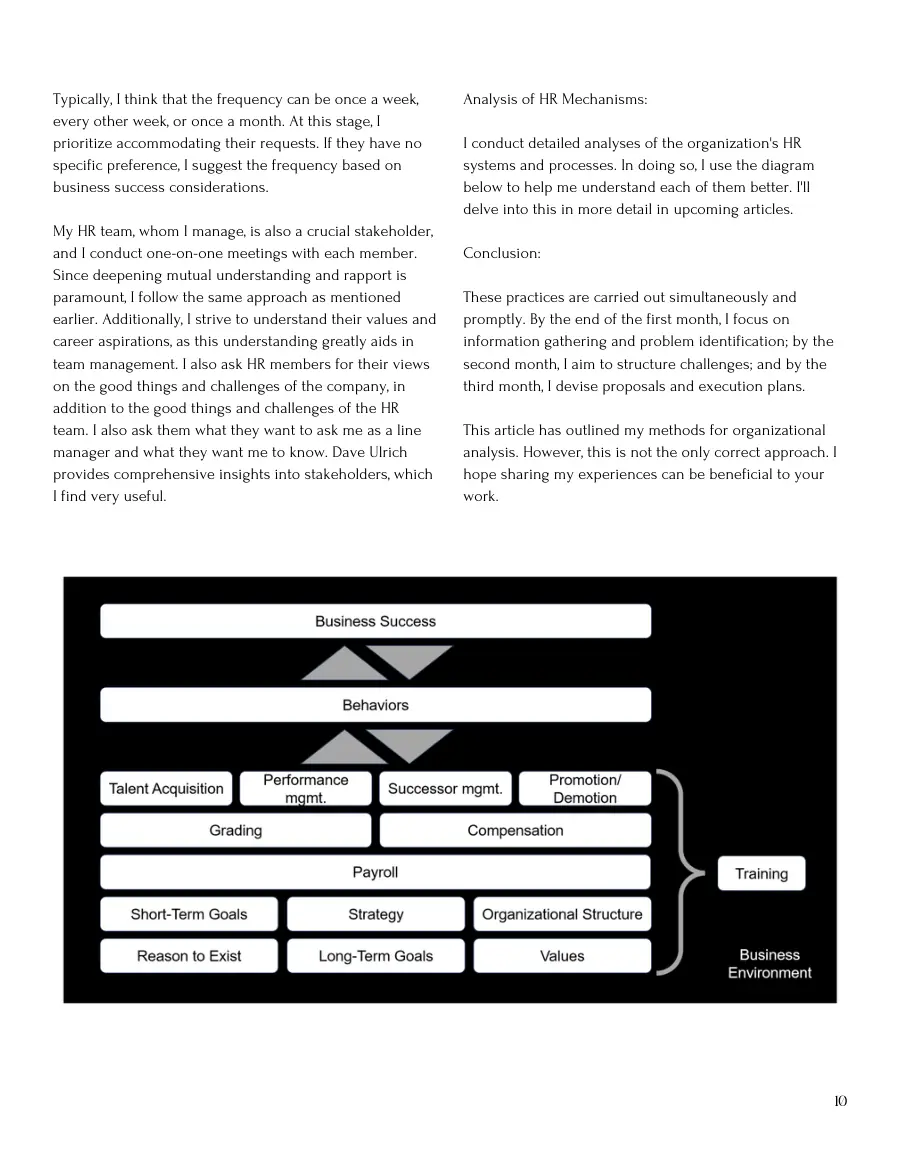
Analysis of HR Mechanisms:
I conduct detailed analyses of the organization's HR systems and processes. In doing so, I use the diagram below to help me understand each of them better. I'll delve into this in more detail in upcoming articles.
Conclusion:
These practices are carried out simultaneously and promptly. By the end of the first month, I focus on information gathering and problem identification; by the second month, I aim to structure challenges; and by the third month, I devise proposals and execution plans.
This article has outlined my methods for organizational analysis. However, this is not the only correct approach. I hope sharing my experiences can be beneficial to your work.