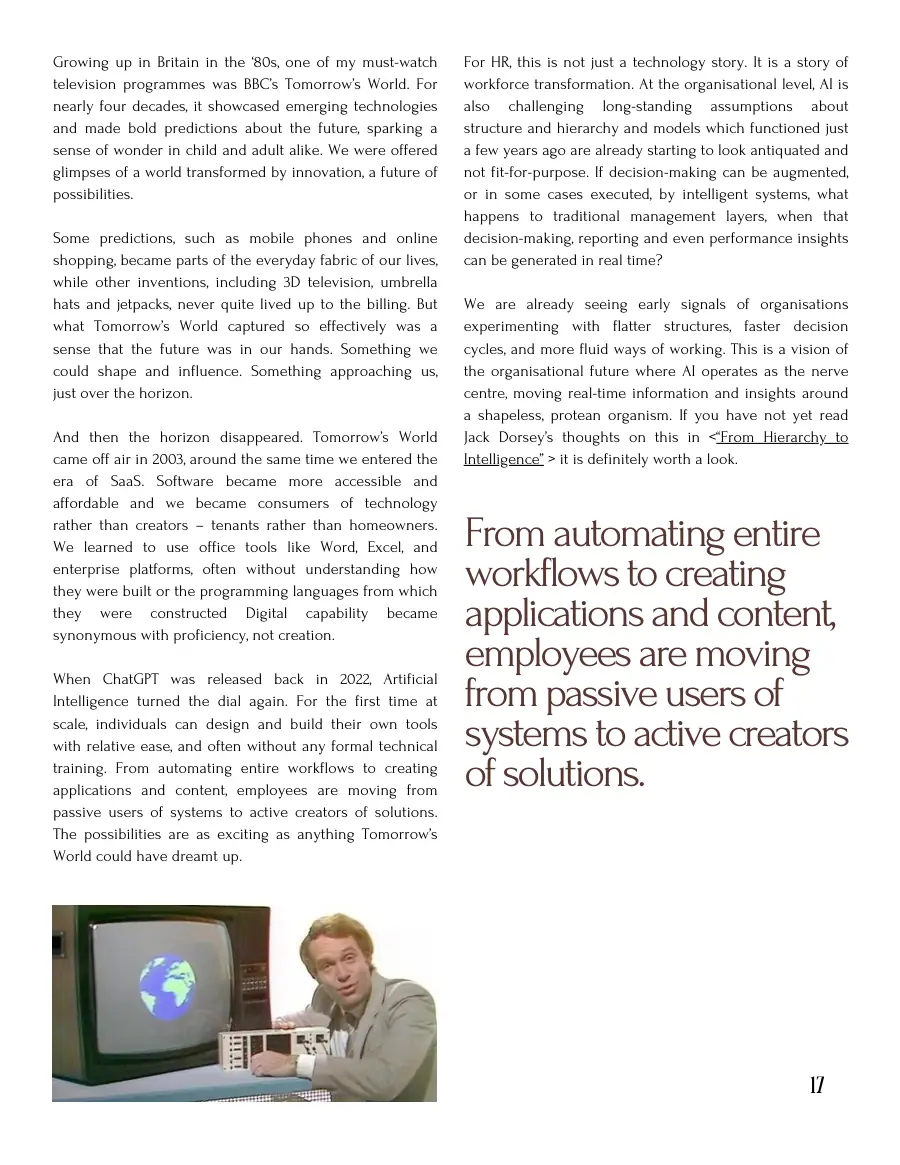
Growing up in Britain in the '80s, one of my must-watch television programmes was BBC's Tomorrow's World. For nearly four decades, it showcased emerging technologies and made bold predictions about the future, sparking a sense of wonder in child and adult alike. We were offered glimpses of a world transformed by innovation, a future of possibilities.
Some predictions, such as mobile phones and online shopping, became parts of the everyday fabric of our lives, while other inventions, including 3D television, umbrella hats and jetpacks, never quite lived up to the billing. But what Tomorrow's World captured so effectively was a sense that the future was in our hands. Something we could shape and influence. Something approaching us, just over the horizon.
And then the horizon disappeared. Tomorrow's World came off air in 2003, around the same time we entered the era of SaaS. Software became more accessible and affordable and we became consumers of technology rather than creators – tenants rather than homeowners. We learned to use office tools like Word, Excel, and enterprise platforms, often without understanding how they were built or the programming languages from which they were constructed. Digital capability became synonymous with proficiency, not creation.
When ChatGPT was released back in 2022, Artificial Intelligence turned the dial again. For the first time at scale, individuals can design and build their own tools with relative ease, and often without any formal technical training. From automating entire workflows to creating applications and content, employees are moving from passive users of systems to active creators of solutions. The possibilities are as exciting as anything Tomorrow's World could have dreamt up.
For HR, this is not just a technology story. It is a story of workforce transformation. At the organisational level, AI is also challenging long-standing assumptions about structure and hierarchy and models which functioned just a few years ago are already starting to look antiquated and not fit-for-purpose. If decision-making can be augmented, or in some cases executed, by intelligent systems, what happens to traditional management layers, when that decision-making, reporting and even performance insights can be generated in real time?
We are already seeing early signals of organisations experimenting with flatter structures, faster decision cycles, and more fluid ways of working. This is a vision of the organisational future where AI operates as the nerve centre, moving real-time information and insights around a shapeless, protean organism. If you have not yet read Jack Dorsey's thoughts on this in “From Hierarchy to Intelligence” it is definitely worth a look.
At the same time, the impact of AI is unlikely to be evenly distributed. While some managerial and knowledge-based tasks may be automated or augmented, human-centric roles such as those requiring empathy, judgement, and interpersonal interaction, remain critical. The future of work may not simply be about job loss, but job redistribution and redefinition.
The result is a tension that HR leaders must actively navigate. On one hand, AI enables unprecedented efficiency and personalisation. On the other, it raises complex questions about workforce design, capability building, and organisational culture. To use an analogy, as the individual bee gains agency and greater autonomy over how they work, what does that mean for the hive? And beyond the workplace, broader systemic challenges are emerging.
Our education systems, in many cases, would not be unfamiliar to our parents or even our grandparents, with the focus more on standardisation rather than building adaptability. Our economic models are heavily reliant on stable employment and predictable income tax structures. Data security, ethical AI use, and geopolitical considerations add further layers of complexity and potential danger on which regulation is already struggling to get a grip.
The pace of change only amplifies these challenges. Unlike previous technological shifts, which unfolded over decades, AI-driven transformation is happening in real time, and often in ways that are difficult to fully anticipate. As HR leaders, then, we need to make some quick but thoughtful interventions.
Firstly, we need to rethink how work is designed. Jobs can no longer be viewed as static roles defined by fixed tasks. Instead, they must evolve into dynamic combinations of human and machine capabilities.
Secondly, we need to reframe capability, prioritising adaptability over specific skills. The ability to learn, unlearn, and relearn will become more valuable than mastery of any single tool or process.
Thirdly, leadership models will need to be evolved. As organisations become less hierarchical and more networked, influence, decision-making, and accountability will look very different from traditional command-and-control structures. Finally, HR must own AI governance within organisations. This includes not only policies and ethics, but also ensuring that employees are equipped— and empowered—to engage with these technologies effectively and safely. Failure to do so will not only incur risk to the organisation but also frustrate employees, many of whom are already using AI at home more than they are in the office.
The organisations that succeed will not be those that simply adopt AI tools, but those that rethink how work itself is organised, and who adjust their organisations accordingly.
Tomorrow's World imagined a future driven by technology. That future has arrived, but maybe not in the way we expected. The change has come, but it is more complex, more immediate, and it puts us all in the driving seat. The question is no longer whether technology will reshape the workplace, but whether our organisations, and our people strategies, can keep pace.