Miho Takiguchi currently serves as a director of organization development at Universal Studios Japan LLC (USJ) and is an accomplished leader with decades of experience in talent management, organizational development (OD), and diversity, equity, and inclusion (DE&I), shares her journey and perspectives on building resilient, inclusive organizations. Drawing from her work with global corporations such as AIG, AstraZeneca, and USJ, Miho discusses the foundations of OD, the strategic importance of D&I, and the future of work.
Q: Could you start by giving us an overview of your career journey? What inspired you to focus on organizational development, inclusion, and diversity?
Miho: My interest in organizational development was sparked during my MBA studies in England back in the late 1990s. I had a professor who emphasized that no matter how advanced technology becomes, people remain the cornerstone of organizational success. This insight resonated with me, highlighting the critical role of culture, vision, and psychological principles in driving business performance.
I started my career at Royal Holdings Co., managing customer relations for hospitality and in-flight meal services. After gaining cross-cultural experience studying and working in London, I joined AIG upon returning to Japan. Over 14 years, I transitioned from learning the insurance industry to leading global talent development initiatives, eventually becoming Head of HR for American Home Assurance in Japan. At AstraZeneca, I expanded my OD expertise, delving into team dynamics, coaching, and diversity and inclusion (D&I). Currently, at Universal Studios Japan, I am challenged by the unique task of engaging over 15,000 team members including hourly paid employees with the inclusive mindset—a complex yet rewarding experience.
Q: Why did you end up deciding to join Universal Studios Japan?
Miho: I joined Universal Studios Japan (USJ) for two main reasons. First, I was excited about the opportunity to explore a completely new industry. I had worked in insurance and pharmaceuticals, and I was looking for something different. The entertainment industry, with its unique challenges and organizational structure, was a fresh and intriguing prospect for me. USJ, especially with more than 10,000 hourly paid team members, offered an opportunity to apply my organizational development expertise in a way I had never done before. I was particularly interested in how I could help communicate and instill the company’s DE&I vision, among the hourly paid team members, which was a challenge I had never encountered.
The second reason I joined was because of the people I met during the interview process. I was truly impressed by the passion and enthusiasm of the team. The managers I spoke with were deeply committed to the park and constantly thinking about how to deliver the best experience for guests and team members. There was a genuine authenticity in the way they spoke about their work.
I remember one conversation with Masako Taguchi, Senior Vice President of Human Resources Division, USJ, who was refreshingly honest about both the struggles and strengths of the organization. This openness and sincerity during the interview process made it a memorable and positive experience for me, and it was a key factor in my decision to join USJ.
Q: There’s a lot of confusion between talent management and organizational development - for you personally, what’s the key difference?
Miho: When it comes to the difference between Organizational Development (OD) and Talent Management (TM), I think it is important to first understand that OD focuses on team dynamics and relationships.
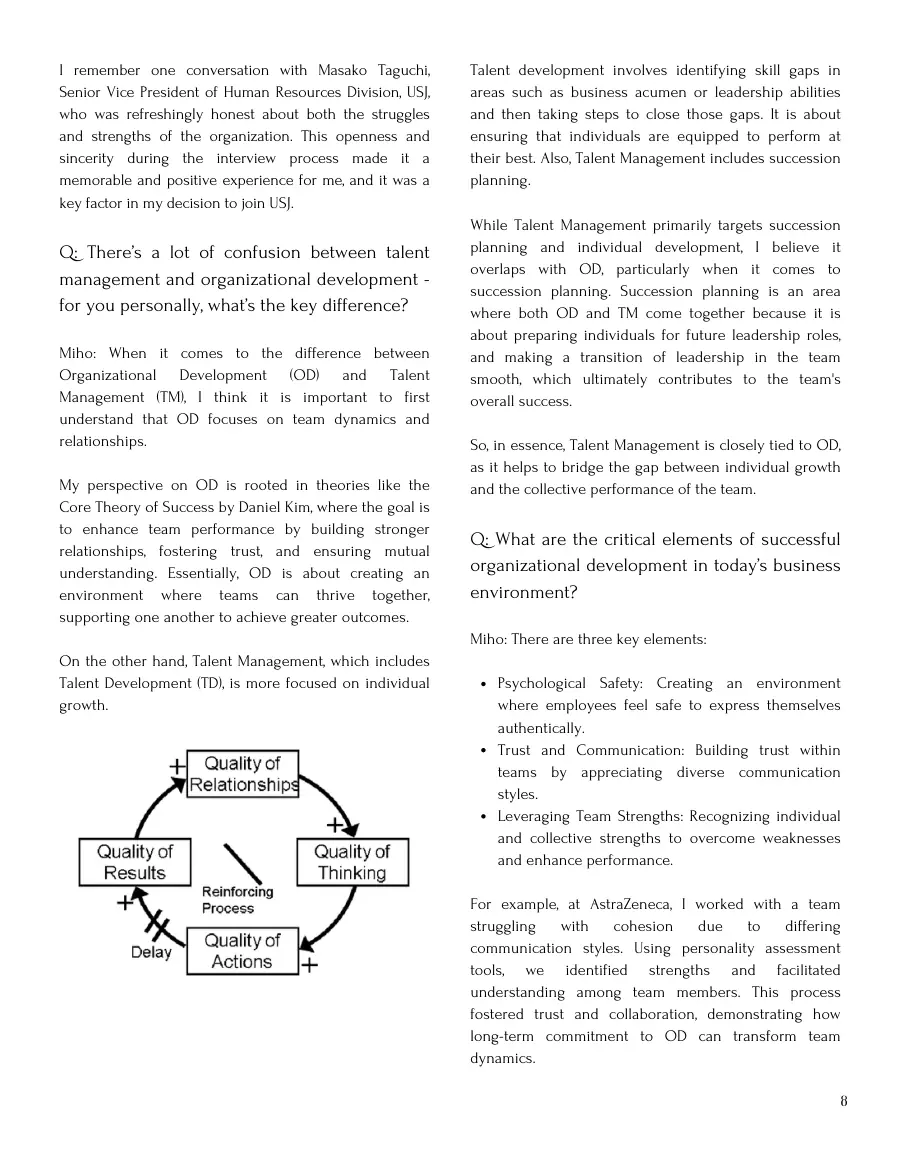
My perspective on OD is rooted in theories like the Core Theory of Success by Daniel Kim, where the goal is to enhance team performance by building stronger relationships, fostering trust, and ensuring mutual understanding. Essentially, OD is about creating an environment where teams can thrive together, supporting one another to achieve greater outcomes.
On the other hand, Talent Management, which includes Talent Development (TD), is more focused on individual growth.
Talent development involves identifying skill gaps in areas such as business acumen or leadership abilities and then taking steps to close those gaps. It is about ensuring that individuals are equipped to perform at their best. Also, Talent Management includes succession planning.
While Talent Management primarily targets succession planning and individual development, I believe it overlaps with OD, particularly when it comes to succession planning. Succession planning is an area where both OD and TM come together because it is about preparing individuals for future leadership roles, and making a transition of leadership in the team smooth, which ultimately contributes to the team's overall success.
So, in essence, Talent Management is closely tied to OD, as it helps to bridge the gap between individual growth and the collective performance of the team.
Q: What are the critical elements of successful organizational development in today’s business environment?
Miho: There are three key elements:
- Psychological Safety: Creating an environment where employees feel safe to express themselves authentically.
- Trust and Communication: Building trust within teams by appreciating diverse communication styles.
- Leveraging Team Strengths: Recognizing individual and collective strengths to overcome weaknesses and enhance performance.
For example, at AstraZeneca, I worked with a team struggling with cohesion due to differing communication styles. Using personality assessment tools, we identified strengths and facilitated understanding among team members. This process fostered trust and collaboration, demonstrating how long-term commitment to OD can transform team dynamics.
Q: Why are inclusion and diversity essential to an organization’s success? How do you engage stakeholders who may see DE&I as a secondary priority?
Miho: Inclusion and diversity are fundamental to innovation, decision-making, and long-term sustainability. Diverse teams bring varied perspectives, enabling better decisions and aligning the organization with market demographics. Moreover, fostering a culture of psychological safety encourages employees to share creative ideas without hesitation, driving innovation.
For stakeholders who may not prioritize DE&I, I focus on building alliances with senior leaders who can champion its importance. Tools like quick-reference guides and consistent reinforcement help embed DE&I into everyday decision-making. Change takes time, but persistence ensures these values become integral to the organization.
Q: Could you share some best practices for leadership development? How can companies better prepare employees for leadership roles in a hybrid work environment?
Miho: Effective leadership development starts with a clear organizational purpose. Leaders must understand not only their responsibilities but also the why behind their roles. In my opinion, companies should also redefine leadership as a role of service rather than authority. Managers should focus on supporting their teams, fostering collaboration, and enabling individual growth.
In hybrid work environments, emotional intelligence and adaptability are paramount. Leaders need to build strong virtual connections, establish trust, and ensure inclusivity in distributed teams. Providing training on these skills is crucial for preparing employees for modern leadership challenges.
Q: What emerging trends in OD, DE&I, or talent management are you most excited about? How will these trends shape the future of work?
Miho: When I think about the upcoming trends in Organizational Development (OD), Inclusion and Diversity (DE&I), and Talent Management (TM), one of the key themes that stands out to me is wellness. This isn't just about physical wellness but also mental wellness. As organizations continue to evolve, there's an increasing emphasis on ensuring that employees are healthy both mentally and physically. The future of OD will likely place greater focus on helping individuals not only perform well at work but also maintain their well-being, as this is crucial for long-term success.
The core purpose of OD is to maximize team performance and to do this, individuals need to be in the right state of mind and health. A team that is mentally and physically well is far more effective. Additionally, it’s about fostering a deeper sense of empathy and understanding within teams. While self-awareness and self-care are important, OD should encourage individuals to think beyond themselves and prioritize collaboration and mutual understanding. This shift towards wellness will likely be a defining factor in OD over the next five to ten years, as organizations recognize that nurturing the whole person, not just their work output, is essential to achieving sustainable success.
These trends reflect a future where agility, inclusivity, and purpose-driven leadership are essential. Organizations that embrace these shifts will be better equipped to navigate change and drive innovation.
Q: What advice would you give to professionals starting out in OD, DE&I, or talent management today?
Miho: Learn the business as quickly as possible, go see and find out by listening to what exactly happening in a team. First-hand information is the best. This is not only for those starting out in OD, D&I, or talent management but for all the businesspersons, who focus on developing self-awareness and vulnerability. Acknowledging your own imperfections is key to growth and success in these fields. Unless you practice these, you will not be able to lead and facilitate team coaching. Rely on the diversity within your team to achieve collective goals, and never underestimate the power of collaboration.
Q: You seem to really enjoy working at USJ. What do you think lies at the heart of what makes this such a great organization to work for?
Miho: One of the things I’m most proud of is our commitment to diversity, equity, and inclusion. We’ve received numerous awards in these areas, and I truly believe it’s because we live these values every day. We already have a wonderfully diverse team, and we foster a flexible work environment that allows people to truly be themselves.
For example, we offer support tailored to various life stages and family situations, called “My Time” which you can use for important moments for your family members including pets. We recognize that for some of us, pets are just as much a part of the family as anyone else. It is just one of the ways we ensure inclusivity and acknowledge what matters most to our employees.
I also love that we have the CSR theme “Love Has No Limit.” One of the activities is “Thanks Love Month” instead of Mother’s Day and Father’s Day. This initiative really reflects who we are as a company. We focus on being inclusive for everyone, including those who may not have a traditional family structure. To me, it is all about recognizing and celebrating the people who mean something to you. Inclusion is something we continue to champion through events like LGBTQ+ Inclusion Month and Persons with Disabilities Inclusion Month. We would like to make sure every single team member feels they belong here, and all the guests feel they are welcome and can experience exciting moments in the park.
Before we finished, I made sure to thank Makana Partners for introducing me to this opportunity. I am incredibly grateful to be part of such an inclusive and dynamic organization. For me, it is about more than just policies and programs—it’s about creating an environment where everyone feels valued and can thrive. That is the vision I bring to fostering inclusive, high-performing workplaces, and it’s what drives me every day.