In this article, I would like to write about HR Business Partner. The term HR Business Partner (HRBP) has been around for some time, but its role and responsibilities vary greatly depending on the organization. In many companies, HRBPs closely engage with individual departments to drive strategy. However, the required roles and priorities can differ based on the organization’s size and industry. If you were asked to list three things that an HRBP ultimately does, what would you list? The answers would likely differ across organizations.
I would list three: contributing to the development of business strategy, leading the creation of an organizational structure to realize the business strategy, and leading the assignment of the right talent to the appropriate boxes within that structure. I will write about each of these in subsequent parts.
Contributing to the Development of Business Strategy
The first ultimate role of an HRBP, as I see it, is to contribute to the development of business strategy. I define an HR Business Partner as someone who, leveraging their expertise in the HR domain, acts as a partner to their department’s head and contributes to achieving that department's goals. Department heads are responsible for various tasks, but one of their key responsibilities is creating both long-term and short-term business strategies to achieve their departmental goals, as well as leading the execution of those strategies. As the department head’s partner, the HRBP plays a crucial role in contributing to the creation of these strategies.
The scope of responsibility for setting departmental goals may vary across organizations. In some cases, department heads define their goals themselves, while in others, these goals are predetermined. Similarly, the reason to exist (purpose), values, and long-term goals (vision) of a department may either be established by the department head or handed down by the organization. If the department head has the authority to define the department’s purpose, values, and long-term goals, the HRBP’s role includes supporting the creation of these elements. This might involve drafting proposals, facilitating feedback from stakeholders, and finalizing the details.
Regardless of the approach, department heads are ultimately responsible for formulating their department’s business strategy. Supporting this process is an essential role for HRBPs.
Leading the Creation of an Organizational Structure to Realize the Business Strategy
The second ultimate role of an HRBP is to lead the creation of an organizational structure to realize the business strategy. To implement a business strategy, a suitable organizational structure is indispensable. As discussed in a previous issue, no organizational structure is perfect. Each has its own pros and cons, and the optimal structure depends on the specific strategy and the current state of the organization.
The HRBP, as an HR expert, evaluates the business strategy and organizational context to propose the most appropriate structure. This might be a pure functional structure, a hybrid model combining divisions and functions, or another configuration tailored to the organization’s needs.
The structure also includes defining individual roles or positions—referred to as “boxes.” For each box, the HRBP leads to define responsibilities and authorities. For example, the HRBP can define the responsibilities and authorities of boxes in terms of regions, or in terms of products and services. They can also be defined in terms of customer segments or job types. The HRBP also consider reporting lines, such as which box reports to which box. It also takes into account the span of control, such as how many boxes are managed by one management box.
The HRBP drafts and proposes the organizational structure that includes the above, receives feedback from the relevant stakeholders, including the head of the department, and leads the creation of the organizational structure for the department.
Leading the Assignment of the Right Talent to the Appropriate Boxes Within That Structure
The third ultimate role of an HRBP is to lead the assignment of the right talent to the appropriate boxes within that structure. The boxes that make up the organizational structure created in the previous part have defined responsibilities and authorities. In other words, ‘The personnel who are responsible for that box are expected to achieve the results of XXX. In order to achieve these results, they can make appropriate use of the necessary authority of XXX’. In some cases, it also defines the knowledge, skills and experience required to take on the role.
HRBPs, as HR expert, recommend the best-fit individuals for these boxes or provide feedback on candidates proposed by department heads. Additionally, they facilitate discussions to ensure the right decisions are made. In addition to the short-term perspective, HRBPs also consider the most suitable personnel to take on the role of the box from a long-term perspective. Even if an organization grows over the long term, if there are no suitable personnel to take on the respective roles, the continuity of the organization may be disrupted. To prevent this, it is necessary to think strategically about the people who can take on the responsibilities of these boxes from a long-term perspective. If there is a box that does not exist now but is needed in the long-term business strategy, it is also necessary to strategically and systematically consider the personnel who can take on that box.
When the above is ideally done, the personnel in charge of the boxes will achieve the required results for their respective boxes by appropriately utilizing the authority of their boxes and fulfilling their responsibilities. If the required results are achieved in each of the boxes, the business strategy is realized, and the business objectives are achieved. In doing so, the organization can deliver value to their respective stakeholders.
You may feel that these ideas are idealistic or disconnected from reality. This may seem idealistic. However, progress toward this ideal can be made step by step. This is why I dared to use the word ‘ultimately’. HRBPs often handle a wide range of tasks daily, including responding to consultations and requests from department heads and other employees, executing routine HR operations, and managing deadlines. These responsibilities might seem unrelated to business strategy, but they play a vital role in organizational operations.
I believe this is an important point: HRBPs are still involved in a wide range of tasks, many of which play a vital role in the running of the organization. However, I believe that even as they carry out their day-to-day work, being aware of the ultimate direction they should be aiming for will lead to greater results in the long term. To this end, I think about how they can carry out what they are doing now to get as close as possible to where they should be aiming, and work on what is in front of them. For example, when responding to a small request from a department head, they can try to understand what they are trying to achieve and what they are currently aware of as a problem in the conversation. They might even be able to make a small suggestion in response to that awareness of the problem. In this way, step by step, they can eventually be able to devote more time to all three. And this will lead to even greater achievements than now.
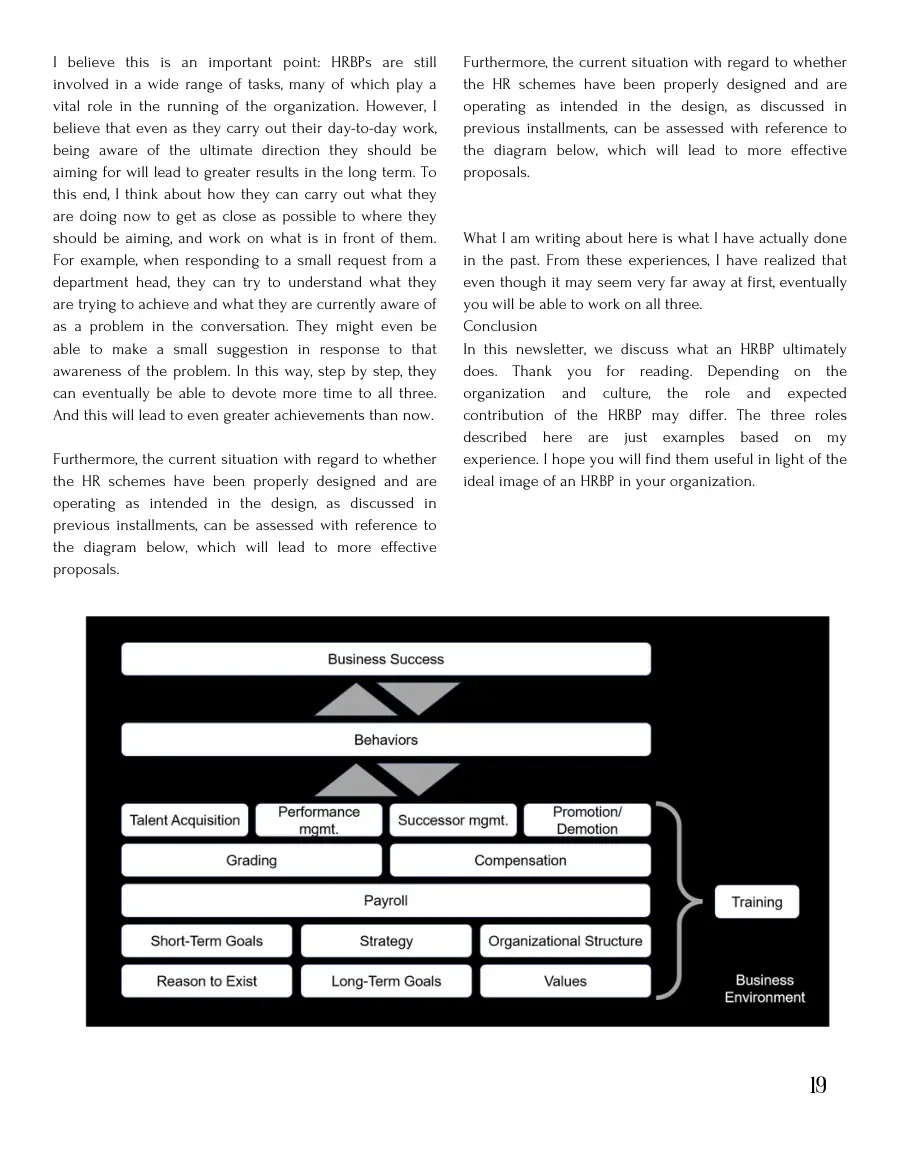
Furthermore, the current situation with regard to whether the HR schemes have been properly designed and are operating as intended in the design, as discussed in previous installments, can be assessed with reference to the diagram below, which will lead to more effective proposals.
What I am writing about here is what I have actually done in the past. From these experiences, I have realized that even though it may seem very far away at first, eventually you will be able to work on all three.
Conclusion
In this newsletter, we discuss what an HRBP ultimately does. Thank you for reading. Depending on the organization and culture, the role and expected contribution of the HRBP may differ. The three roles described here are just examples based on my experience. I hope you will find them useful in light of the ideal image of an HRBP in your organization.