Fittingly, the Japanese word for love is AI (愛). Based on a number of cultural, demographic, and industrial factors, Japan may end up “loving” this new technology. No, I’m not talking about the chatbot romances we’ve seen in the headlines recently. I’m talking about a fundamental shift that could simultaneously solve some of the biggest challenges currently facing Japan and position it well for the future.
Craftmanship (職人技)
Japan is world-famous for a beautifully unique culture whose depth is uncommon in an ever-globalized and commoditized world. In particular, the passion and commitment that is poured into their craftsmanship, Shokunin Kishitsu (職人気質) or Monozukuri (ものづくり) in Japanese, has a long and rich history dating back hundreds or even thousands of years.
However, this rigorous attention to details and perfection can be seen beyond the concrete forms of traditional craftmanship. While Japan is well known for this craftmanship, in traditional crafts like the study of tea (茶道) or crafting intricate wooden boxes (寄木細工), it permeates the everyday culture in subtle ways that are not always obvious.
As you live and work in the country, you see little signs of care and thought in every aspect of Japanese life. Whether it is the gradual start of an escalator to accommodate the elderly or the local coffee shop that deliberately chooses flowers that evoke the feeling of the current season. In fact, attention to the season is even seen in the grocery store aisle with special displays and sales for seemingly every week of the year.
This careful preservation of centuries of techniques, deliberate selection, and meticulous aesthetic is something that many Japanese worry they are losing as demographic forces continue to shrink the population. The work ethic and preservation of tradition, equally foundational to Japanese culture, have allowed the country to continue many of these traditional crafts to the present day, but the time and math of Japan’s current population is relentlessly moving in a downward trajectory.
The Way Forward
Japan, more than ever, and maybe more than other nations, needs a solution that can not only capture deep and rich context, but also scale to meet both the existing domestic demand and the growing global demand for such artisanship. Generative Artificial Intelligence may provide some of the solutions here. Current Large Language Models have done a fantastic job of capturing the information and human knowledge across the internet and large corpuses of text. However, they are not without their limitations.
While the chatbots themselves provide detailed information that can seem expert to those unskilled in a particular domain, the results may contain hallucinations and inaccuracies, leading to poor user experience.
To avoid these sloppy outcomes, many of the best user experiences have come from a more curated approach. Those with deep knowledge in a particular domain can refine the model or application to build fit-for-purpose systems tailored specifically to their industry.
Of course, as with all quality software, rigorous testing and the tireless pursuit of building a quality product are key. But this will not be surprising to those who embrace the craftsman’s mentality.
Here, the Japanese work ethic and craftsman mindset are crucial not only in building high-performing LLM-enabled solutions, but also in capturing the depth of detail and aesthetic so core to Japanese culture. With the right human-first (as well as culture-first) approach, to design, systems can be built that capture the nuance of the language and the mindset so key to the beauty of Japanese life
Challenges
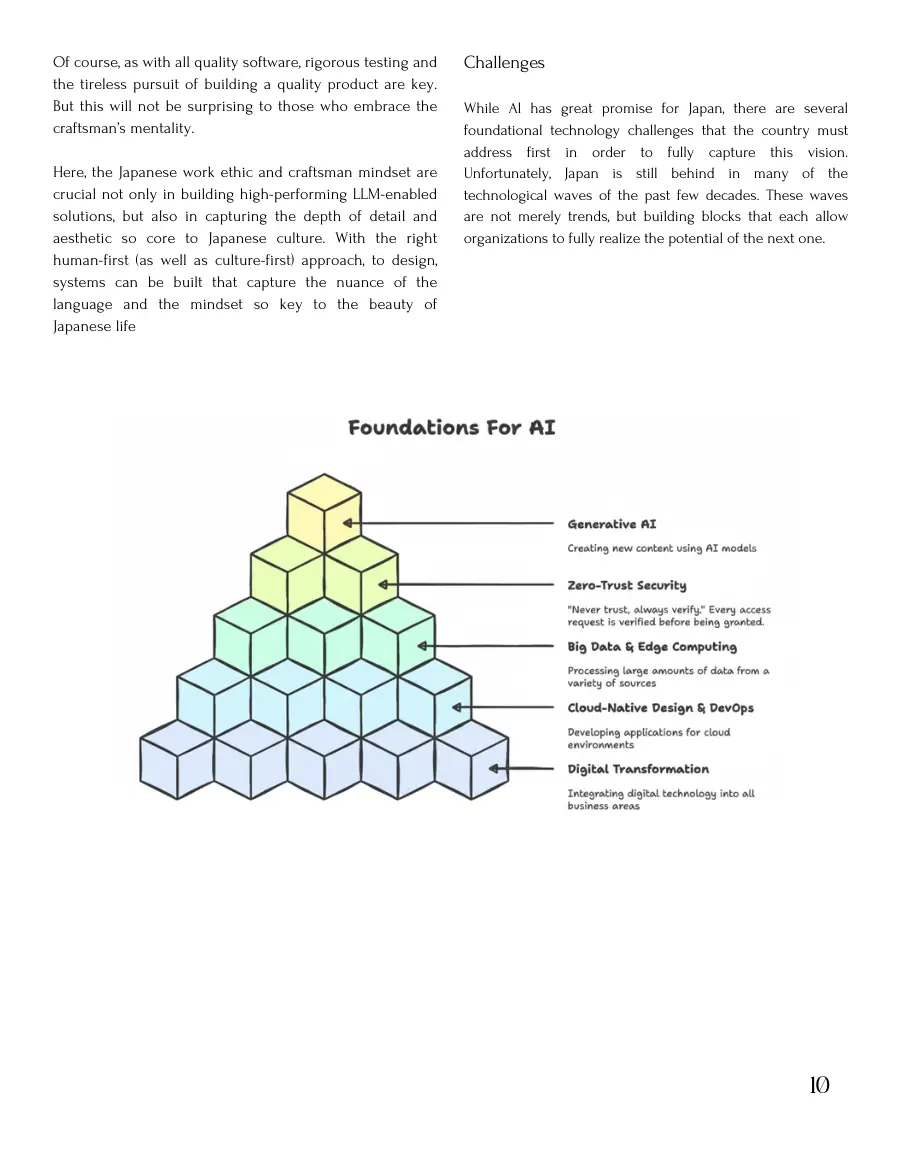
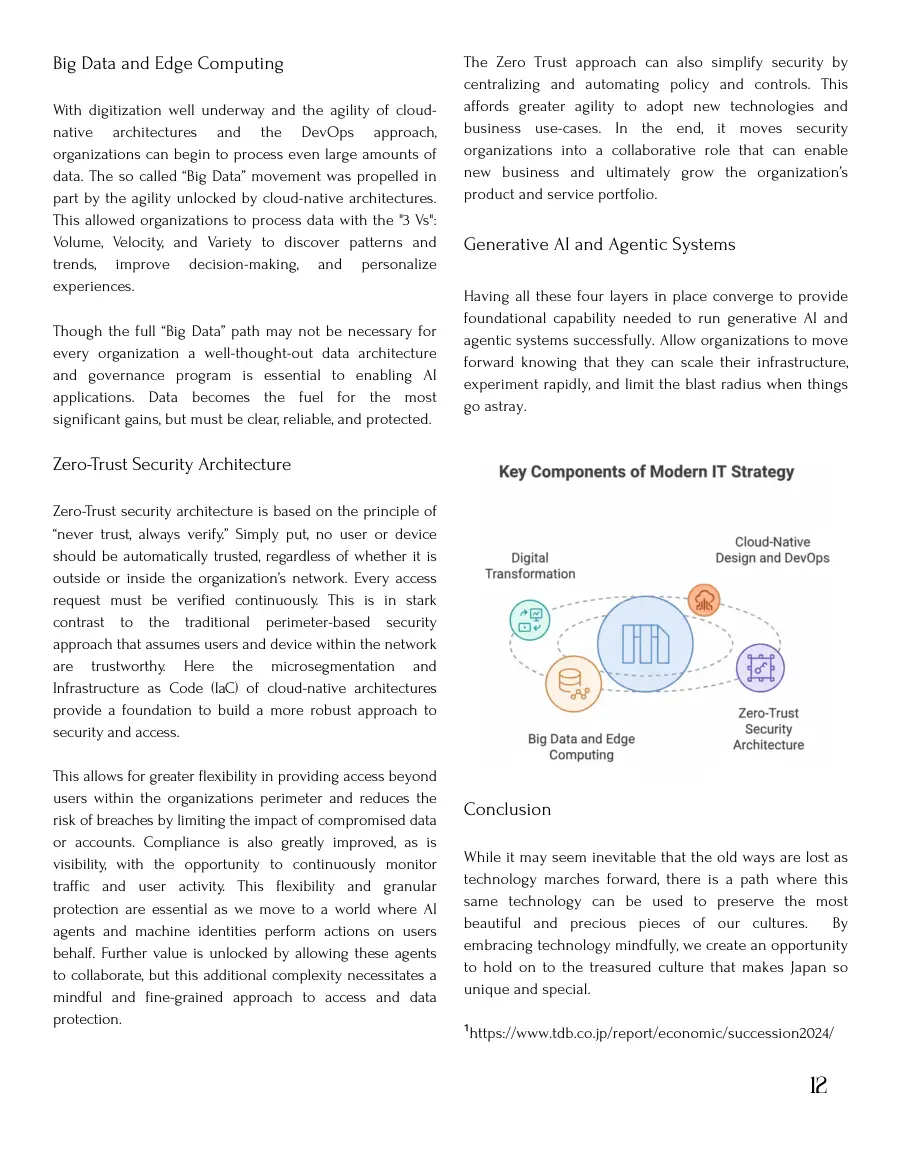
While AI has great promise for Japan, there are several foundational technology challenges that the country must address first in order to fully capture this vision. Unfortunately, Japan is still behind in many of the technological waves of the past few decades. These waves are not merely trends, but building blocks that each allow organizations to fully realize the potential of the next one.
Digital Transformation
Many organizations have struggled to complete digital transformations, DX, and still rely on manual, often paper-based, work. This simply will not scale and in fact is already putting existing knowledge at risk of being lost forever. This is even more pronounced for small or family businesses. A 2024 survey showed that 52.1% of businesses have no successor¹.
AI, and Generative AI specifically, is dependent on data. While fine-tuning and customization requires far less data than building a LLM itself, even end-users of chatbots like ChatGPT get the best results when providing context specific data through PDFs or detail text on the topic in question.
DevOps to Platform Engineering
While digitizing operations is key, simply having the data in digital form is not enough. The flexibility, scalability, and speed that modern AI systems require are a key infrastructural foundation. Organizations that have adopted cloud or cloud-native designs have found an agility that allows them to utilize the latest technology and customize it for their organization and use cases without getting stuck in the long procurement cycles and endless maintenance of traditional IT.
A key point here is that it does not require companies to move everything they have to the public cloud. In fact, the complementary DevOps movement of the Cloud era is one of the most important aspects for unlocking speed and agility in the digital world. Cloud-native architectures, including containerization, give companies a repeatable and consistent approach to deploying (and recovering) their systems even in private data centers.
This fundamental shift of treating infrastructure (and cybersecurity) as a software product leads to greater collaboration and business enablement. In this way central IT teams are no longer provisioning individual servers, but maintaining a “platform” that serves the business’s needs. This idea of using DevOps and self-service capability is often referred to as Platform Engineering.
Platform Engineering is the goal for teams that build Infrastructure as code through a software development lifecycle. This includes product management that listens for pain points and drives the platform towards low friction and fast enablement for users and the core business.
These techniques can be applied to in-house datacenters and, in fact, there are a variety of private cloud technologies that can be used to realize these gains. Even the most conservative organization should find value, agility, and resilience as it adopts this approach to IT infrastructure.
One should note, however, that public cloud providers still provide an edge in giving companies immediate access to the latest technologies for experimentation and development. They are delivered with a reliable, world-class infrastructure in place that, at the very least, should be considered for research and development efforts.
Big Data and Edge Computing
With digitization well underway and the agility of cloud-native architectures and the DevOps approach, organizations can begin to process even large amounts of data. The so called “Big Data” movement was propelled in part by the agility unlocked by cloud-native architectures. This allowed organizations to process data with the "3 Vs": Volume, Velocity, and Variety to discover patterns and trends, improve decision-making, and personalize experiences.
Though the full “Big Data” path may not be necessary for every organization a well-thought-out data architecture and governance program is essential to enabling AI applications. Data becomes the fuel for the most significant gains, but must be clear, reliable, and protected.
Zero-Trust Security Architecture
Zero-Trust security architecture is based on the principle of “never trust, always verify.” Simply put, no user or device should be automatically trusted, regardless of whether it is outside or inside the organization’s network. Every access request must be verified continuously. This is in stark contrast to the traditional perimeter-based security approach that assumes users and device within the network are trustworthy. Here the microsegmentation and Infrastructure as Code (IaC) of cloud-native architectures provide a foundation to build a more robust approach to security and access.
This allows for greater flexibility in providing access beyond users within the organizations perimeter and reduces the risk of breaches by limiting the impact of compromised data or accounts. Compliance is also greatly improved, as is visibility, with the opportunity to continuously monitor traffic and user activity. This flexibility and granular protection are essential as we move to a world where AI agents and machine identities perform actions on users behalf. Further value is unlocked by allowing these agents to collaborate, but this additional complexity necessitates a mindful and fine-grained approach to access and data protection.
The Zero Trust approach can also simplify security by centralizing and automating policy and controls. This affords greater agility to adopt new technologies and business use-cases. In the end, it moves security organizations into a collaborative role that can enable new business and ultimately grow the organization’s product and service portfolio.
Generative AI and Agentic Systems
Having all these four layers in place converge to provide foundational capability needed to run generative AI and agentic systems successfully. Allow organizations to move forward knowing that they can scale their infrastructure, experiment rapidly, and limit the blast radius when things go astray.
Conclusion
While it may seem inevitable that the old ways are lost as technology marches forward, there is a path where this same technology can be used to preserve the most beautiful and precious pieces of our cultures. By embracing technology mindfully, we create an opportunity to hold on to the treasured culture that makes Japan so unique and special.
¹ https://www.tdb.co.jp/report/economic/succession2024/